
The Difference between “Bisexual” and “Pansexual” exemplified by Zheng Banqiao and Yuan Mei
Two 18th c. Chinese cultural influencers and their multi-gender attractions.

Happy Pansexual Visibility Day! The terms “bisexual” and “pansexual” in reference to sexual orientation may have only come into use in the English language in 1892 and late 20th century respectively. But people who embody these identities lived long before then, and the distinctions between the two orientations are certainly not limited to the English-speaking world.
Friends, you’ve already met our Qing dynasty queer forbears Zheng Banqiao and Yuan Mei in earlier posts. They admired each other’s artistic achievements and bonded over a shared attraction to men,[1] but according to what they wrote and what others wrote about them, their nature of attraction worked differently.
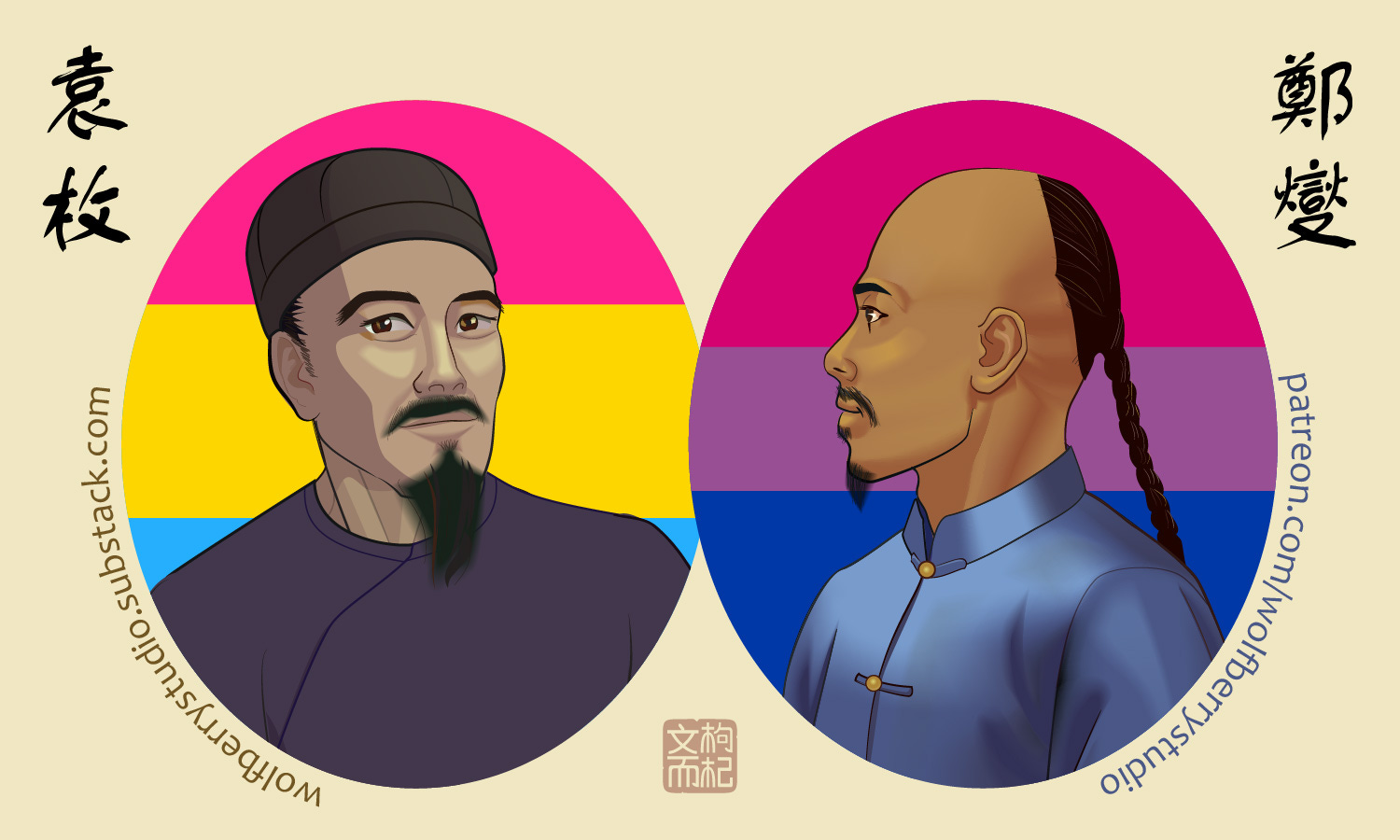
Zheng Banqiao
The Chinese poet Zheng Xie, aka Zheng Banqiao, was known to have both female and male lovers. He wrote the poem《止足》in 1743,[2] musing on entering a life stage where joys and pleasures outweigh sorrows and disappointments. Among the pleasures that he listed in 《止足》 were “the young wife in her apartment, happy without suspicion; the young man under the flowers, clever and embraceable.”[3]
Some years later, Zheng wrote a letter to his friend, the poet-calligrapher Zhiqing Shanren, in which he described his distinct attraction to physical attributes of females and physical attributes of males.[4]
Zheng Banqiao again declared his sexual preferences in his 1760 autobiographical essay, referencing the 1st c. BCE Emperor Ai who famously shared his bed with a male courtier Dong Xian and also married Dong’s sister. [5]
Bisexuality is attraction to individuals from two or more genders. For example, a bisexual person can be attracted to what they consider to be distinguishing attributes of men, and to what they consider to be distinguishing attributes of women. Zheng appreciated women and men each for their unique qualities.
Yuan Mei
A pansexual person is indifferent to the gender of the people to whom they are attracted. They are attracted to qualities other than gender. This undifferentiated attraction is described in writings by and about Yuan Mei.
Yuan Mei, a poet friend of Zheng Xie, describes pansexuality in one of his poems.
Liu Xiachang (alternative pronunciation ‘Xiashang’), a young male student of Yuan Mei, accompanied the elderly poet on his travels. Along the way, Yuan Mei wrote poems about Liu’s liaisons with both men and women.
In 1784, the two were traveling in Guangdong when Liu Xiachang met a 17-year-old doorman Yuan Shijin. Shijin went through much effort to arrange a tryst, but at the appointed time, Shijin’s employer received an urgent summons, and Shijin had to leave with him in great haste. The young men parted in sorrow. Yuan Mei then wrote a poem for Liu. Here is the first half of the poem:
At Pearl River, a wind blows apart the tryst of two young men
Whose pearly tears fall in strings of pink translucence,
Their destined time together is short, for change arises in an instant.
In deep passion, who still recognizes the distinction between female and male?
References
[1] Bisexual 18th century artist Zheng Banqiao waxes poetic on male anatomy